That word changes who absorbs the GST, how the figure has to be displayed and what the law expects you to do about it. We’ll work through both meanings, when each one shows up and how to tell which version you’re looking at.
The two terms
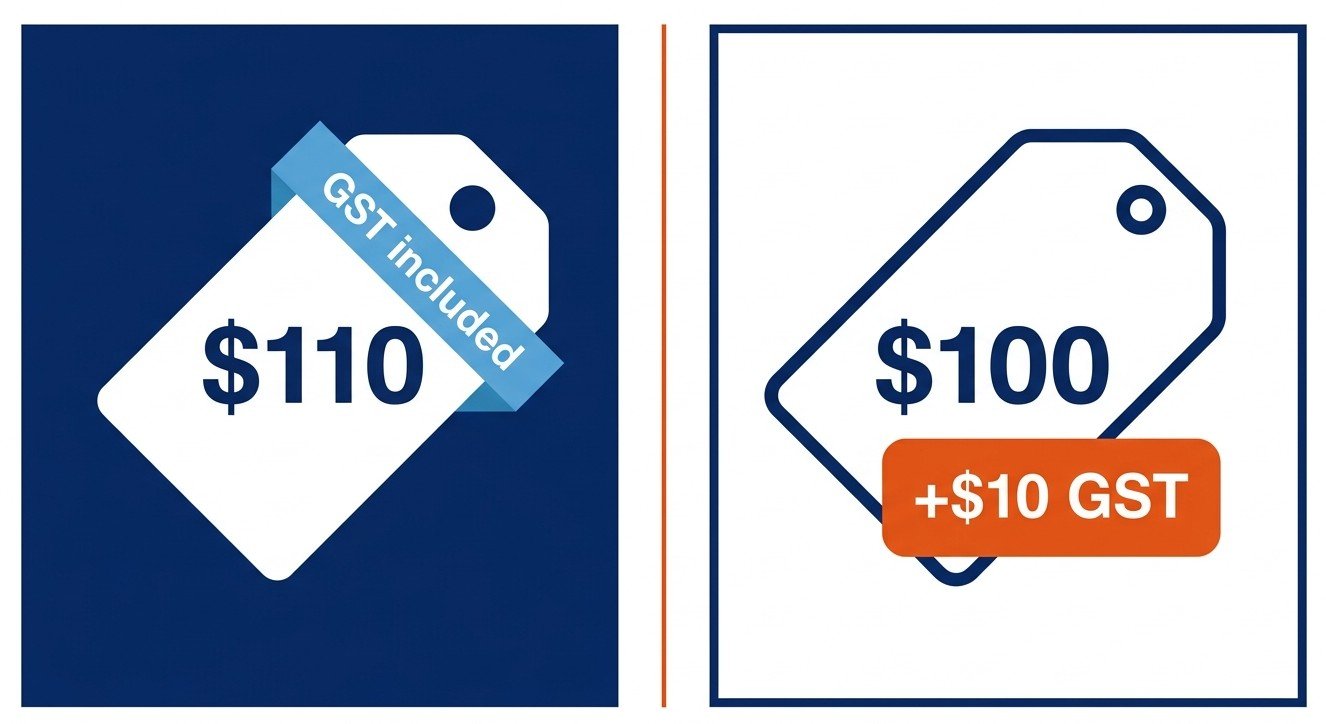
GST inclusive means the price already contains the 10% GST. A $110 inclusive price is $100 net plus $10 GST. The buyer pays $110 and that’s the end of it.
GST exclusive (often written ‘ex-GST’, ‘plus GST’ or ‘+ GST’) means GST has not yet been added. A $100 ex-GST quote becomes $110 once 10% GST is added at invoice time. The buyer still pays $110 in the end, but the conversation that gets them there is different.
Same final price. Different starting figure. The risk is that a buyer reading ‘plus GST’ as ‘inclusive’ will be surprised by the gap when the invoice arrives.
When you’ll see each
- Retail to consumers (B2C). Inclusive. A price tag at Bunnings, Kmart, Coles, JB Hi-Fi or Officeworks shows the figure the customer will pay at the till. The 10% GST is baked in.
- Business-to-business (B2B). Often exclusive. A bookkeeper quoting another business, a wholesaler sending a price list to retailers, a freelance designer pitching an agency – all of these typically use ‘plus GST’ figures because both parties expect the GST to be added at invoice time and reclaimed as a credit later.
- Property and large transactions. Either, but the contract spells it out. A commercial lease will almost always specify whether the rent figure is GST-inclusive.
- Online retail. Inclusive – Australian Consumer Law does not relax just because the shop is a website.
- Imports. The supplier’s invoice may show GST-free, but the Australian Border Force will collect 10% GST at the border on the customs value plus duty plus international transport and insurance.
If you’re not sure which version you’re reading, look for the words ‘plus GST’, ‘ex-GST’ or ‘GST exclusive’ near the figure. If those words aren’t there, the law expects the price to be inclusive.
What the law actually requires
The Australian Competition and Consumer Commission, which enforces Australian Consumer Law on pricing, sets out a clear rule on its Price displays page: businesses must display ‘a total price that includes taxes, duties and all unavoidable or pre-selected extra fees’ when advertising or quoting prices to the general public.
The ACCC specifically warns against the most common dodge: ‘Simply stating that 10 per cent GST will be added to the price at time of payment may mislead consumers’. A retailer who advertises ‘$50 + GST’ on a sign visible to consumers is risking a breach – the inclusive figure has to be at least as prominent as any component.
Three points the ACCC nails down on its component pricing page:
- The single GST-inclusive price must be displayed prominently.
- If you break the price into components (net price, GST, fees), the components must be ‘in close proximity to, and not given greater prominence than, the final GST-inclusive price’.
- Businesses selling only to other businesses are exempt from the single-price rule.
That last point is the legal basis for B2B quotes showing ‘ex-GST’ figures. A wholesaler’s price list isn’t being shown to consumers, so the ACL’s prominence rule doesn’t bite.
How to convert between them
Two formulas cover the back-and-forth.
- Exclusive to inclusive: Net × 1.10 = Gross. A $200 ex-GST quote becomes $220 inclusive.
- Inclusive to exclusive: Gross ÷ 1.10 = Net. A $220 inclusive figure becomes $200 ex-GST.
- Inclusive to GST line only: Gross ÷ 11 = GST. A $220 inclusive figure contains $20 of GST.
For a single conversion, the GST calculator on this site handles both directions in one tool. The dedicated Add GST calculator covers exclusive-to-inclusive only, and the Reverse GST calculator covers inclusive-to-exclusive. ASIC’s MoneySmart publishes a free GST calculator that does the same maths if you want a second opinion.
Where the difference catches people out
Five situations we see go sideways more often than they should:
- Quoted on the phone, invoiced on paper. A tradie says ‘$1,200 for the job’ over the phone and the homeowner hears ‘final price’. The invoice arrives at $1,320 and the conversation goes cold. Quote ‘plus GST’ or ‘inclusive of GST’ out loud, every single time.
- Marketplace listings. A small seller listing on a B2C marketplace lists ‘plus GST’ figures because they’re used to writing wholesale invoices. The platform usually treats the listed price as inclusive – the seller absorbs the GST instead of the buyer paying it. Read the marketplace’s own rule before you list.
- Commercial property listings. A lease ad showing ‘$45 per square metre’ without specifying inclusive or exclusive can shift annual rent on a 280-square-metre warehouse by $1,260 in GST. Get the inclusive vs exclusive answer in writing before signing anything.
- Consumer-facing service quotes. A cleaning service emailing a residential customer with ‘two hours $90 + GST’ is technically advertising to a consumer, which the ACCC treats as a single-price scenario. The service should quote $99 inclusive instead, or face a complaint.
- Cross-border sales. Selling to a New Zealand customer through your Australian Shopify store doesn’t mean the Australian GST lifts off automatically. The export rules under GST-free sales require evidence the goods left Australia within the time the ATO sets.
What a tax invoice should show
A compliant tax invoice in Australia shows the inclusive total, the GST line broken out and a clear indication of which is which. The ATO’s tax invoice rules require the supplier’s name and ABN, the invoice date, a description of what was sold, the GST amount payable, the buyer’s identity for invoices over $1,000 and a statement that the document is a tax invoice.
The phrase ‘Total includes GST of $X’ or ‘GST-inclusive total’ is what most accounting software prints by default. Xero, MYOB and QuickBooks all default to inclusive on consumer-facing templates and exclusive on B2B templates – check the template setting before you send your first batch.
One last thing
If you’re writing quotes for the first time, set up two invoice templates in your accounting software – one labelled ‘B2C’ (inclusive, single-price prominent) and one labelled ‘B2B’ (exclusive, with the GST line broken out separately). Picking the right template at quote time saves you the awkward follow-up call where you explain to a customer that the price they signed off on is going up by $48.
- ACCC – Price displays
- ACCC – Component pricing (advertising and selling guide)
- ACCC – Service sector warning on advertised GST prices
- business.gov.au – Display prices
- Australian Taxation Office – Tax invoices
- Australian Taxation Office – GST-free sales (exports)
- ASIC MoneySmart – GST calculator