
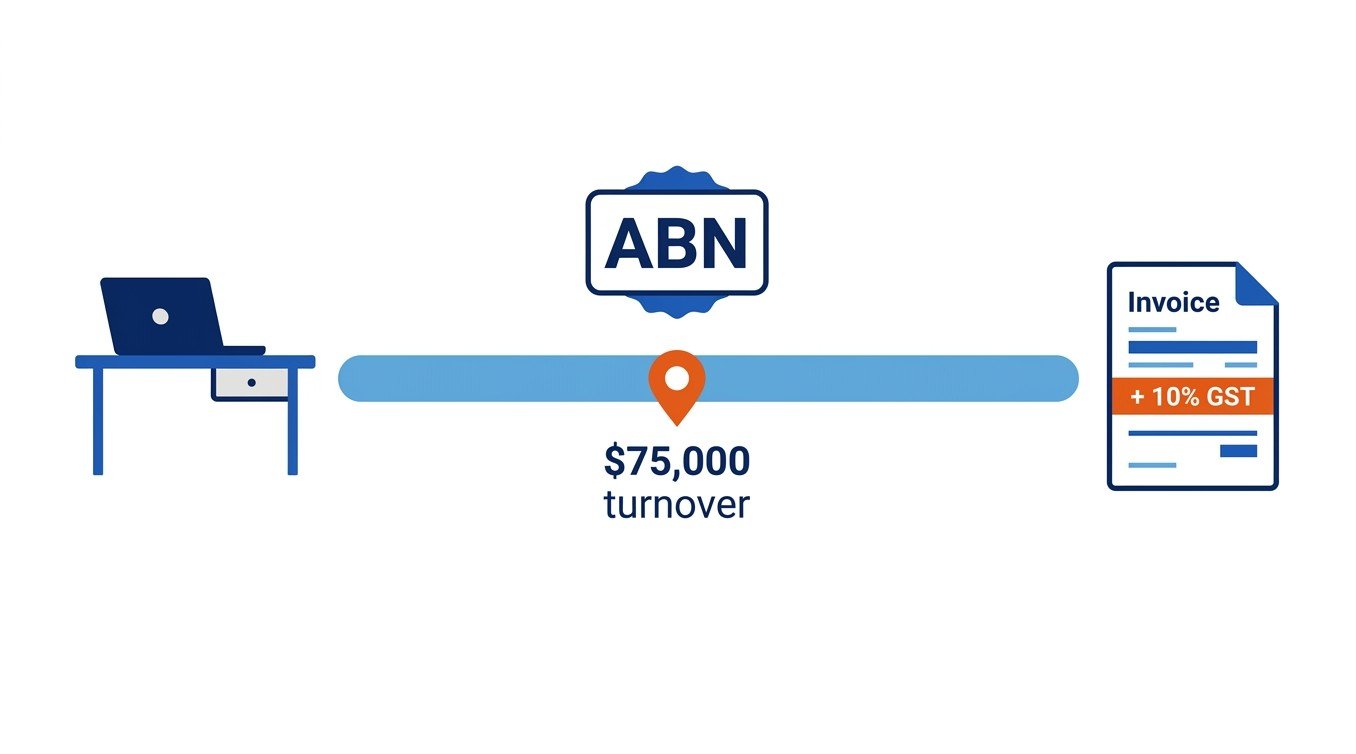
A Sydney electrician finishes a $4,400 commercial fit-out in late June, banks the cash and notices the rolling 12-month figure has just hit $77,000 for the first time. Twenty-one days later, GST registration is supposed to be live. Most tradies don’t notice the threshold until they cross it; the ones who do plan ahead avoid the awkward year-of-transition.
The basic rule is simple: sole traders under $75,000 of annual turnover don’t have to register for GST. Sole traders above it must, within 21 days. The harder part is the year you cross from one to the other, the voluntary-registration question on the way up and the day-to-day rhythm changes once registration is live.
This post walks through each of those, plus the mistakes we see most often in the first year of sole-trader GST.
The two thresholds the ATO uses
The ATO defines two figures and a sole trader is registered if either one trips the limit.
- Current GST turnover. Total taxable sales for the current month and the previous 11 months. If this exceeds $75,000, you’re required to register.
- Projected GST turnover. Total taxable sales for the current month and the next 11 months. If you reasonably expect this to exceed $75,000, you’re required to register.
- Either trigger registration. You don’t get to wait for both to cross.
- The exception. Even if current turnover is at the threshold, you don’t have to register if you can show projected turnover will be below it – a one-off contract that won’t repeat is the typical scenario.
The ATO’s Registering for GST page is the official rule book. Keep an eye on the rolling 12-month figure in your accounting software each month; the ATO expects you to know.
The 21-day rule
Once turnover crosses $75,000, registration must happen within 21 days. Miss the window and the ATO can collect GST on every sale made between the trigger date and the registration date – even if you didn’t include GST in those invoices.
In practice this means a tradie who hits $76,000 in mid-November and doesn’t register until February could be on the hook for 1/11 of every December and January invoice, plus penalties. The hook is hard to walk back.
The fastest way to avoid it is a calendar reminder set for the end of each month, prompting a quick check of the rolling 12-month figure. Xero, MYOB and QuickBooks all show this on the dashboard.
Voluntary registration: should you?
Sole traders below $75,000 can register voluntarily. The decision usually comes down to four questions:
- Are most of your customers GST-registered businesses? If yes, voluntary registration is probably worth it. Charging $110 inclusive instead of $100 ex-GST doesn’t cost B2B customers a cent (they claim the GST back) and lets you claim GST credits on every supplier invoice you receive.
- Are most of your customers consumers, and do you compete on price? If yes, voluntary registration costs you. Lifting your prices 10% to keep the same net revenue is unpopular with consumers; absorbing the 10% eats into margin. Most consumer-facing sole traders wait for the threshold rather than register early.
- Are you about to make a big capital purchase? A $33,000 ute, a $5,500 saw bench, a $4,400 espresso machine, an $1,800 laptop refresh – all generate meaningful GST credits if the business is registered when the purchase is made. Some tradies time registration to the same quarter as a major purchase.
- Do you have time for quarterly BAS? Registration brings a 30-minute-a-month bookkeeping habit and a 2-hour quarterly BAS. If the sole trader runs the books themselves, that’s time off the tools.
The right answer depends on the mix. A B2B consultant earning $50,000 with $5,000 of supplier GST credits a year is better off registered. A B2C dog-walker earning $40,000 with almost no business expenses is usually better off unregistered.
What changes after registration
Five things shift the day GST registration is live:
- Every invoice becomes a tax invoice. Add ‘Tax invoice’ at the top, your ABN and the GST line for each item. The GST calculator on this site handles the inclusive vs exclusive splits in one tool.
- Quoting language matters. Verbal quotes need to specify ‘plus GST’ or ‘inclusive of GST’ every single time. The ACCC treats vague quotes as a consumer-protection issue under Australian Consumer Law.
- You start collecting GST on customer payments. $110 lands in your account; $10 of that is the ATO’s, not yours. Most successful sole traders move 1/11 of each customer payment to a separate ATO sub-account the day it lands.
- You can claim GST credits on business expenses. Tools, software subscriptions, fuel, accountant’s fees, the business portion of phone and internet, equipment. The Reverse GST calculator handles each receipt’s divide-by-11 split.
- Quarterly BAS lands in your inbox. The Business Activity Statement reports 1A (GST collected from customers) minus 1B (GST credits on supplier invoices). Net is what you owe – or what the ATO refunds.
The ATO’s How GST works page is the official starting point for new registrants.
The mental shift: $110 in your account isn’t $110 of yours
This is the single most useful concept for a new GST-registered sole trader.
When a customer pays a $110 GST-inclusive invoice, $100 is yours and $10 is the ATO’s. Treating the full $110 as revenue is the fastest way to scramble for cash at BAS time.
The simple habit: every customer payment into the operating account triggers a same-day transfer of 1/11 to a sub-account. Some banks (CommBank, Westpac, NAB or ING) let you set the rule automatically with each deposit. By the end of a quarter, the BAS payable is sitting in the right account with no extra mental load.
A worked example. A graphic designer has a quiet quarter with $33,000 of inclusive billings and $4,400 of supplier expenses (GST-inclusive software, computer accessories, contractor invoices):
- 1A: $33,000 ÷ 11 = $3,000
- 1B: $4,400 ÷ 11 = $400
- Net BAS: $3,000 − $400 = $2,600 owing
- Cash position at lodgement: $2,600 already sitting in the ATO sub-account, no scramble required
Lodgement takes 20 minutes through myGov, payment is automatic from the sub-account, life continues.
Quoting changes after registration
Two scenarios catch out new GST-registered sole traders.
For B2B work, quoting ‘plus GST’ is the norm. A bookkeeper quoting a $1,200 ex-GST monthly fee is fine, because the client claims the GST back on their own BAS. The client’s net cost is the same as the ex-GST quote.
For B2C work, the ACCC requires the GST-inclusive figure to be displayed prominently. A tradesperson quoting a homeowner $880 ‘plus GST’ in writing is technically advertising to a consumer in a single-price way. The compliant version is $968 inclusive, with the GST line shown smaller alongside.
We’ve seen sole traders cop ACCC complaints for $50 + GST signage on consumer-facing material. The fix is straightforward (rewrite the quote as inclusive) but the conversation isn’t fun.
The quarterly BAS rhythm
Most sole traders lodge BAS quarterly under Simpler BAS – the three-field version of the form for businesses under $10 million turnover. Three lines: G1 (total sales inclusive of GST), 1A (GST on sales) and 1B (GST credits on purchases). The ATO’s Simpler BAS GST bookkeeping guide is the official reference.
Lodgement deadlines: 28 October (Q1), 28 February (Q2), 28 April (Q3) and 28 July (Q4). A registered tax or BAS agent gets you four extra weeks each quarter.
The ATO’s interactive GST calculation worksheet handles the maths once your figures are clean.
Sole trader mistakes we see often
Five errors that come up in the first year of registration:
- Spending the GST set-aside. $110 of customer payment lands and the full $110 funds groceries, rent, the new ute battery. Three months later, the BAS payable is overdue and the only money available is the next quarter’s takings.
- Claiming GST credits on personal expenses. A laptop used 70% for work and 30% for streaming is 70% claimable. The ATO’s apportionment rules apply to most overlap items – phone, internet, vehicle.
- Forgetting the rolling 12-month threshold check. A sole trader who scaled up midway through the year hits $75,000 in February and doesn’t register until June. The ATO can collect GST on every March, April and May invoice retrospectively.
- Register-deregister cycles to chase short bursts of work. Voluntarily registered sole traders are expected to stay registered for at least 12 months. Multiple register-deregister cycles trigger ATO scrutiny.
- Mixing GST and income-tax records. Sole traders sometimes treat the 1/11 as ‘revenue’ and then claim it again as an expense, which inflates both sides of the books and skews the income-tax return.
When you can deregister
If your turnover drops below $75,000 and you don’t expect it to rise again, you can cancel GST registration. Two practical steps:
- Cancel through the ATO’s Cancelling your GST registration service. Cancellation is effective from a date you nominate.
- Lodge a final BAS for the period up to the cancellation date.
Deregistration before the 12-month minimum, or in a way the ATO sees as turnover-management, can attract scrutiny. Get an accountant’s view before pulling the trigger.
When to call an accountant
A registered tax or BAS agent’s view is worth the consult fee in four situations:
- You’re approaching $75,000 and aren’t sure whether one-off project income counts toward the threshold.
- You’re considering voluntary registration to claim credits on a major capital purchase.
- Your first BAS is due and you’ve never lodged one before.
- You’re a sole trader in a niche category – property, financial services, food retail – with industry-specific GST rules layered on top of the standard ones.
Most accountants run flat-fee BAS packages cheaper than a single late-lodgement penalty. If you’re billing more than $1,500 a month, the time saved usually pays the fee.
One last thing
The day you register for GST, set up two bank accounts: one for operating, one for the ATO. Move 1/11 of every customer payment to the ATO account the day it lands. Sole traders who do this never have a BAS-time cash crunch; sole traders who don’t develop a relationship with their overdraft. The GST calculator on this site handles the per-invoice maths, and the ATO’s Registering for GST page is the rule book if anything in your situation looks unusual.
- Australian Taxation Office – Registering for GST
- Australian Taxation Office – How GST works
- Australian Taxation Office – Simpler BAS GST bookkeeping guide
- Australian Taxation Office – Cancelling your GST registration
- Australian Taxation Office – Interactive GST calculation worksheet for BAS
- business.gov.au – Register for goods and services tax (GST)
- ACCC – Price displays
For sole traders navigating GST complexities, our team is available to answer your questions and provide guidance tailored to your situation.