
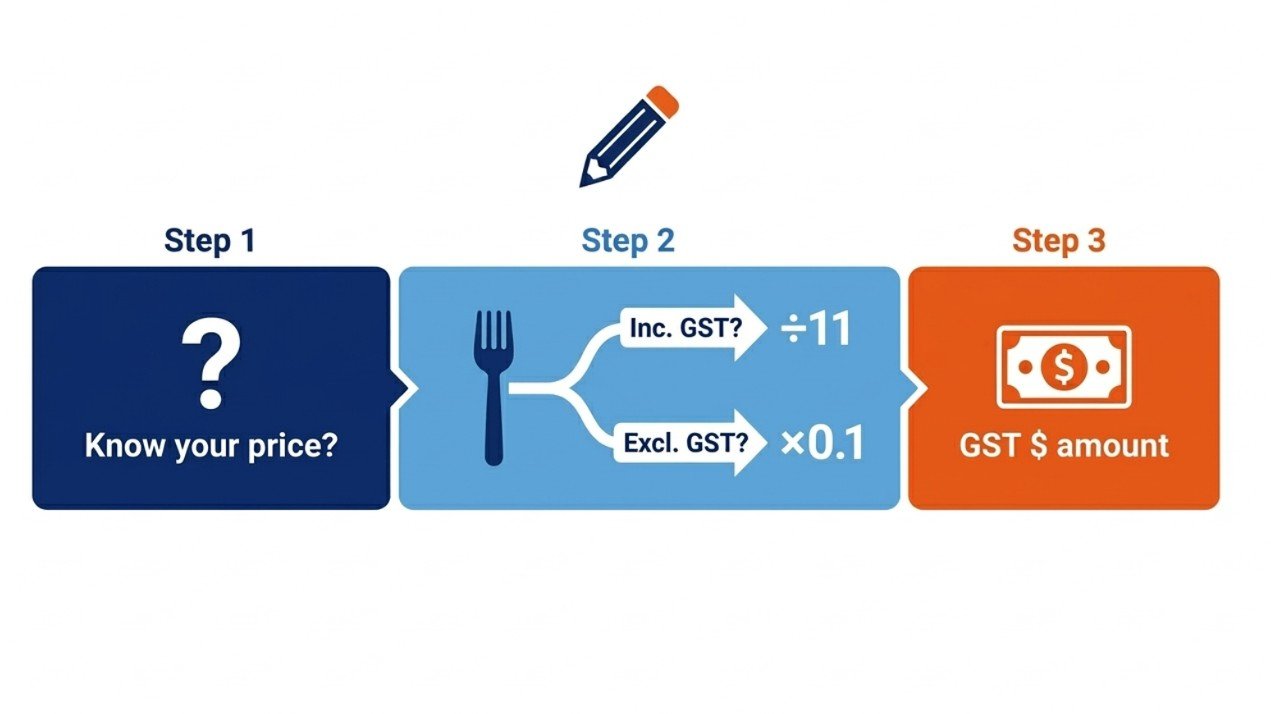
GST is one-eleventh of the inclusive total, not one-tenth. That single fact catches more sole traders out than any other number on the BAS, and it’s where every accurate GST calculation starts.While GST calculations are straightforward for most businesses, Airbnb hosts face unique challenges. For a detailed guide on navigating these complexities, check out GST for Airbnb hosts.Understanding GST calculations is crucial, especially for gig economy workers like Airbnb hosts, who face different registration thresholds. If you’re renting out properties, our guide on GST for Airbnb hosts clarifies when you need to register and lodge BAS statements.For rideshare drivers, understanding GST obligations is crucial from the very first trip. Unlike other small businesses, they don’t benefit from the $75,000 registration threshold. Learn more about GST for Uber drivers to stay compliant and manage your BAS effectively.GST calculations can be tricky, especially for specific industries like ridesharing. For a detailed breakdown of GST obligations for Uber drivers, visit this detailed guide.While the calculation itself is straightforward, many Australians still wonder why GST remains at 10% decades after its introduction — a rate that applies uniformly across most goods and services.Many business owners confuse whether to use one-tenth or one-eleventh when working with GST, which stems from not understanding GST inclusive vs exclusive pricing structures.
The Australian Taxation Office defines GST as ‘a broad-based tax of 10% on most goods, services and other items sold or consumed in Australia’. The rate has held at 10% since 1 July 2000. Once you know the two formulas and where the common slip happens, working out GST is a 10-second job on most invoices.
Why bother getting the maths right
If you’re GST-registered, the figure on every tax invoice and every BAS line has to be exact. Round wrong on a $4,400 quote and you’re either short-charging the customer or under-paying the ATO. Both are fixable; neither is fun.
If you’re not yet registered but you’re approaching the $75,000 turnover threshold the ATO sets for compulsory registration, the same maths becomes a forecasting tool – you can see what an extra job does to your inclusive figures before you take it on.
And if you’re a consumer just sense-checking a receipt? Australian Consumer Law says retail prices shown to you must already include GST, but it doesn’t promise the breakdown is right. We’ve found errors on quotes, supplier statements and even Coles dockets – usually in the supplier’s favour.
What you’ll need
- The dollar figure you’re starting from, gross or net
- A calculator – your phone’s is fine, but the GST calculator on this site handles both directions in one tool
- The tax invoice or receipt if you’re checking someone else’s maths
- A notebook for the BAS-relevant figures – the ATO expects you to keep records for five years
The two formulas
Two equations cover almost every GST calculation in Australia.
Adding GST to a net price:
Net × 1.10 = Gross
Example: a $200 ex-GST quote becomes $200 × 1.10 = $220 once GST is added. The $20 difference is the GST line on your tax invoice.
Removing GST from a gross price:
Gross ÷ 11 = GST
Gross ÷ 1.10 = Net
Example: a $220 gross receipt → $220 ÷ 11 = $20 GST → $220 − $20 = $200 net.
ASIC’s MoneySmart calculator confirms the same two rules: ‘multiply the amount exclusive of GST by 1.1’ to add it, and ‘divide a GST inclusive cost by 11 to work out the GST component’.
The reason you divide by 11 (not 10) when going backwards is that GST is one-eleventh of the inclusive total, not one-tenth. A $110 inclusive price is $100 net plus $10 GST – ten dollars is one-eleventh of $110, not one-tenth. Divide by 10 and you over-state the GST line by 10%, which compounds quietly across a quarter and shows up as a bad BAS reconciliation at the end of it.
Step 1: Work out which direction you need
Half the errors we see start here, before any maths.
If your starting figure does not yet include GST – a wholesale price, a B2B quote, an estimate you’re writing for a customer – you’re adding. If your starting figure already includes GST – a receipt, a final invoice you’ve received, a price tag on a Bunnings shelf – you’re removing.
A quick test. Did the price come with the words ‘plus GST’ or ‘ex-GST’? You’re adding. Did it come from a checkout, a register or a printed receipt? You’re almost certainly removing.
Step 2: Add GST to a net price
Multiply the net figure by 1.10.
A worked example. A plumber in Geelong quotes a kitchen tap fit-out at $480 ex-GST. The customer wants the inclusive figure for their household budget.
$480 × 1.10 = $528
The tax invoice shows $480 net, $48 GST, $528 gross. That $48 is what the plumber will hand on to the ATO at the next BAS. The Add GST calculator does the same arithmetic in one tap.
A second example for the bigger end. A bookkeeping firm in North Sydney quotes a small business client $3,750 ex-GST for an annual package. The inclusive figure is $3,750 × 1.10 = $4,125. The GST line is $375 – exactly one-tenth of the net, and exactly one-eleventh of the gross.
Step 3: Remove GST from a gross price
Divide the gross figure by 11 to find the GST. Subtract that from the gross to find the net.
Worked example. You’ve come back from Bunnings with a receipt for $187 of decking screws. The receipt shows the gross only.
$187 ÷ 11 = $17 GST
$187 − $17 = $170 net
If you’re a tradie claiming the GST credit on your BAS, $17 goes in box 1B (GST on purchases) on the calculation worksheet. The ATO’s interactive GST calculation worksheet handles the BAS-side division automatically, but the Reverse GST calculator is faster for a single receipt.
Step 4: Use the mental shortcuts
You won’t always have a calculator handy.
The move-the-decimal trick is the fastest mental method for adding 10%. Shift the decimal one place to the left to find 10%, then add it on. $250 × 1.10 = $250 + $25 = $275. For removing 10%, the same trick gives you a close enough sanity-check, not a BAS-grade figure – $275 minus 10% is $247.50, near enough to the true $250 net.
For exact GST removal in your head, dividing by 11 stays the rule. With practice you can do round figures in seconds: $66 → $6, $99 → $9, $132 → $12, $385 → $35. The pattern is always there once you’ve spotted it.
Step 5: Handle mixed-supply receipts
This is where bookkeepers come unstuck more often than the maths trips them up.
A grocery receipt from Coles or Woolies usually mixes GST-free items (most fresh food, plain bread, milk) with GST-inclusive items (soft drink, biscuits, ready meals, household goods). The ATO’s GST-free sales list spells out which categories sit outside the 10%.
You can’t take a $94 grocery total and divide by 11 – most of it is GST-free. Look for the GST line at the bottom of the receipt (Coles labels it ‘GST included in this docket’; Woolies puts an asterisk next to taxable items and totals them at the foot). Trust the printed line over the formula whenever the trolley is mixed.
The same caution applies to mixed business receipts. A pub meal that bundles a GST-free service charge with food and drinks needs the line items, not a blanket divide-by-11.
Common mistakes
Five errors we see often, in roughly the order they show up:
- Dividing by 10 instead of 11. Treating GST as one-tenth of the inclusive total over-states it by 10%. A $110 receipt is not $11 of GST – it’s $10. New BAS lodgers get this wrong on their first quarter, fix it, then never repeat it.
- Adding GST to an already-inclusive figure. Multiplying a $110 price tag by 1.10 because you forgot it was already gross gets you $121 – a phantom $11 of tax that doesn’t exist.
- Quoting one figure verbally and another in writing. A tradie says ‘$400 for the job’ on the phone and the homeowner hears ‘final price’. The invoice arrives at $440 and the conversation gets awkward. Quote ‘inclusive of GST’ or ‘plus GST’ out loud, every time.
- Rounding too early. GST is calculated to the cent. If you round the net before multiplying, the gross can sit a few cents away from the bank deposit, and the BAS column won’t match the cash.
- Forgetting GST-free categories. Basic food, most education, most health services, child care and exports are GST-free under the ATO’s rules. Charging GST on a GST-free supply is one of the few errors that’s hard to walk back without re-issuing the invoice.
Troubleshooting: when the numbers won’t reconcile
If the BAS sits a few dollars off, check rounding first. If it’s out by a clean 10%, you’ve probably divided one figure by 10 and another by 11. If a customer queries an invoice, walk them through it in plain dollars (net + GST = gross) rather than percentages – it lands faster, especially with households.
For anything bigger than a rounding mismatch, the ATO’s How GST works page is the authoritative reference, and the MoneySmart GST calculator is the second-opinion tool we use for spot-checks.
One last thing
Set up your accounting software – Xero, MYOB, QuickBooks, whichever runs your books – so the GST line shows on every invoice template by default. Tradies and contractors who fix this on day one save themselves hours of mental arithmetic across the year, and a fortnightly habit of running each receipt through the Reverse GST calculator will catch most supplier rounding errors before they reach the BAS.
- Australian Taxation Office – How GST works
- Australian Taxation Office – Interactive GST calculation worksheet for BAS
- Australian Taxation Office – Registering for GST
- Australian Taxation Office – GST-free sales
- ASIC MoneySmart – GST calculator
The calculators and guides on gstcalculator.net.au are for general information only and do not constitute tax, financial, or legal advice. Consult a registered tax agent for advice specific to your situation.