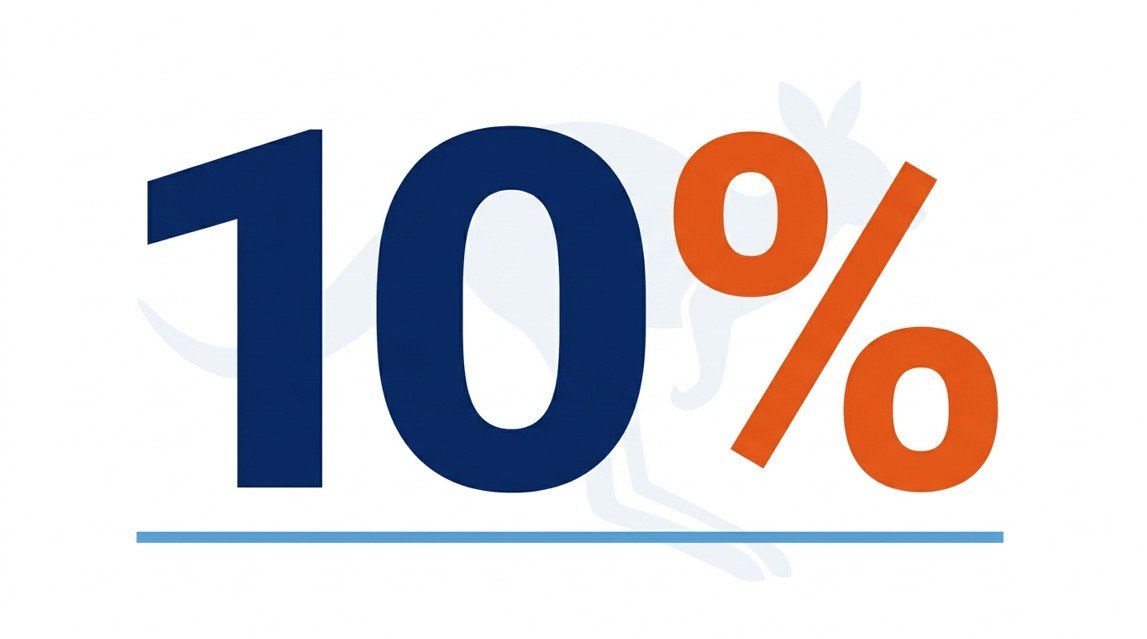
Australians paid around $85 billion in GST in the 2023–24 financial year. The rate behind that figure is 10%, applied to most goods and services. And it hasn’t moved since the day GST started on 1 July 2000. So when you see a price at Coles, Bunnings or JB Hi-Fi, the 10% is already baked in – and on a $1,100 inclusive total, exactly $100 of it is GST.
The rest of this page is a reference: dollar-amount tables, the global comparison, what’s GST-free and a couple of quick tells for spotting whether a price already includes GST.
The current GST rate (2026)
GST in Australia is 10%. Flat, broad-based and the same as it was when it started in 2000. There’s no tiered structure, no different rates for different items – either a sale attracts GST or it doesn’t.
For the formula side (how to add or remove that 10%), see the how to calculate GST page.
Has the GST rate ever changed?
No. The rate has been 10% for the entire time GST has existed in Australia – 26 years as of 2026. Two attempts to lift it have stalled politically:
- 2015. A proposal to raise GST to 15%, floated by then-Prime Minister Tony Abbott. Rejected in cabinet before it reached the public.
- 2019. A think-tank push to lift it to 12.5%, floated again around the federal election. Didn’t gain bipartisan support.
The political maths is part of the reason. Lifting GST requires the agreement of every state and territory under the Intergovernmental Agreement on Federal Financial Relations, which is a high bar. The rate is also seen as regressive – a higher rate hits lower-income households disproportionately – which makes it politically expensive to raise.
So in practical terms: don’t expect 10% to change in the near future. The federal budget projections out to 2028 all assume 10%.
GST rate vs other countries
Australia’s 10% sits on the lower end globally. The same broad-based consumption tax exists in most developed economies, just under different names (VAT in most of Europe, GST in others, sales tax in the US):
| Country | Rate | Tax name |
| Australia | 10% | GST |
| New Zealand | 15% | GST |
| Singapore | 9% | GST |
| Japan | 10% | Consumption tax |
| United Kingdom | 20% | VAT |
| Germany | 19% | VAT |
| France | 20% | VAT |
| Canada (federal) | 5% | GST |
| United States | 0–11% | State sales tax |
The closest comparison is New Zealand – similar economy, similar tax framework, but a 15% rate that applies to almost everything (including basic food, which is GST-free in Australia). The trade-off: NZ collects more revenue at a higher rate, AU keeps a lower rate but with more carve-outs.
How much GST do I pay on $100?
Depends on whether the $100 is GST-inclusive or GST-exclusive.
- If $100 is the price you paid (inclusive), the GST in it is $100 ÷ 11 = $9.09. The ex-GST portion is $90.91.
- If $100 is the ex-GST figure, the GST on top is $100 × 0.1 = $10. The inclusive total is $110.
The same logic applies at any dollar figure – GST is 1/11 of an inclusive price, or 10% of an exclusive price. The two answers describe the same dollar amount from opposite directions.
Quick reference table
GST amounts at common dollar figures, both directions:
| Inclusive total | GST in it | Ex-GST | Check |
| $10 | $0.91 | $9.09 | $9.09 + $0.91 = $10 |
| $50 | $4.55 | $45.45 | $45.45 + $4.55 = $50 |
| $100 | $9.09 | $90.91 | $90.91 + $9.09 = $100 |
| $500 | $45.45 | $454.55 | $454.55 + $45.45 = $500 |
| $1,000 | $90.91 | $909.09 | $909.09 + $90.91 = $1,000 |
| $1,100 | $100.00 | $1,000.00 | $1,000 + $100 = $1,100 |
| $5,000 | $454.55 | $4,545.45 | $4,545.45 + $454.55 = $5,000 |
| $10,000 | $909.09 | $9,090.91 | $9,090.91 + $909.09 = $10,000 |
The $1,100 row is the only one that lands on round dollars – which is why it shows up in every textbook example.
What’s GST-free?
Some sales sit outside the 10% net entirely. The main GST-free categories:
- Most basic, unprocessed food – bread, milk, fresh produce, raw meat, plain rice
- Most education and childcare – university courses, school fees, eligible childcare services
- Most health and medical services – GP consultations, certain medicines and medical aids
- Exports – goods leaving Australia within 60 days of payment
- Some menstrual products – removed from the GST net on 1 January 2019
A registered business making GST-free supplies still claims GST credits on its inputs – which makes GST-free different from input-taxed.
Input-taxed vs GST-free
The two terms get muddled. The difference:
- GST-free. No GST on the sale, but the seller can still claim GST credits on related expenses. Basic food sits here.
- Input-taxed. No GST on the sale, but the seller can’t claim credits either. Residential rent and most financial services sit here.
Both end up looking the same on a customer receipt (no GST line), but the back-office treatment is different.
How to check if a price already includes GST
Three quick tells for an unfamiliar price:
- Look for a separate GST line on the invoice. Required on any AU tax invoice over $82.50, so its presence confirms the price is inclusive.
- Check the wording on a quote. B2B quotes usually say ‘plus GST’ or ‘+ GST’ next to the figure, which means the figure is exclusive. B2C retail prices must legally show the GST-inclusive figure under ACCC rules, so a tag at Bunnings, Officeworks or Coles is always inclusive.
- The clean-dollar test. Ex-GST quotes tend to land on round dollars ($500, $1,000, $5,000). Inclusive prices rarely do.
If you’ve still got a number and don’t know which side of GST it’s on, the safest move is to ask. Running the wrong formula on the right number gives you the wrong answer either way.
FAQs
How much is GST in Australia in 2026?
GST is 10%. The rate has been 10% since GST started on 1 July 2000 and there are no current proposals to change it.
Has the GST rate ever changed?
No. Two political attempts to lift the rate – in 2015 (to 15%) and around 2019 (to 12.5%) – stalled before reaching legislation. The federal budget projections assume 10% will hold for at least the medium term.
How much GST do I pay on $1,000?
Depends on which side of GST the $1,000 is on. If $1,000 is the inclusive price, GST is $90.91 (1/11). If $1,000 is the ex-GST figure, GST is $100 (10%) and the inclusive total is $1,100.
Why is GST 10% and not 15% like NZ?
Two reasons. Politically, GST in Australia requires the agreement of every state and territory to change, which is a much higher bar than NZ’s. Structurally, the original 2000 deal traded a lower rate for a wider net of state taxes being abolished – states accepted 10% because GST revenue replaced what they were giving up.
Is GST included in shop prices?
Yes. ACCC pricing rules require retailers to show GST-inclusive prices to consumers. The price tag at Coles, Bunnings or JB Hi-Fi already has the 10% baked in. Business-to-business quotes are different – those are usually exclusive, with ‘plus GST’ written next to the figure.
Are there any items without GST?
Yes. Basic unprocessed food, most education and childcare, most health and medical services, exports and some menstrual products are GST-free. Residential rent and most financial services are input-taxed (also no GST). Everything else attracts the 10%.
The calculators and guides on gstcalculator.net.au are for general information only and do not constitute tax, financial, or legal advice. Consult a registered tax agent for advice specific to your situation.